

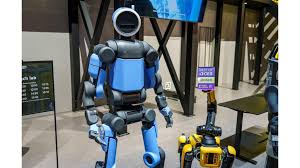
Physical Intelligence, a fast rising San Francisco based robotics firm, has released new research suggesting its latest AI model, π0.7, can guide robots to perform tasks they were never specifically trained on. The development points to what researchers describe as an early step toward a general purpose robot brain capable of learning and adapting in real time.
According to co founder Sergey Levine, the breakthrough lies in what is known as compositional generalisation, where the system combines previously learned skills to solve entirely new problems. In one experiment, the model successfully interacted with an unfamiliar air fryer, drawing from minimal prior exposure and broader training data to complete the task with human guidance.
Researchers noted that the model improves significantly when given step by step verbal instructions, suggesting that robots could eventually be deployed in new environments and coached on the job without retraining. However, the system still struggles with executing complex multi step tasks independently and relies heavily on precise prompting to achieve consistent results.
While the findings have generated excitement, the company maintains that the research is still in its early stages, with no immediate timeline for commercial deployment. Backed by over $1 billion in funding and strong investor interest, Physical Intelligence is positioning itself at the forefront of a new phase in robotics, where adaptability and generalisation may begin to rival the rapid advances seen in large language models.