

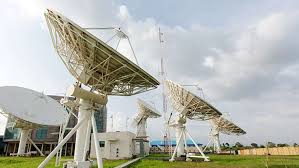
Nigerian Communications Satellite Limited (NIGCOMSAT), the nation’s state-owned satellite operator, has announced a monumental surge in its revenue, climbing to ₦2.2 billion ($1.6 million) in 2025. This marks a significant leap from the ₦650 million ($470,854) generated in the previous year.
Speaking at a press briefing in Lagos, the chief executive, Jane Egerton-Idehen, presented this growth not as a fleeting success but as a deliberate and upward trajectory for the company. Broadcasting remains the cornerstone of NIGCOMSAT’s earnings, contributing over half of its total revenue by serving more than 50% of Nigeria’s licensed broadcasters.
Despite this financial upswing, a cloud of uncertainty looms over the future of Nigeria’s sole operational communications satellite, NigComSat-1R. The satellite, originally built for a 15-year lifespan, has been technically enhanced to function until 2028, with government plans for its replacement that year and an additional satellite in 2029.
However, a contentious $11.4 million dispute over unpaid fees with China Great Wall Industry Corporation (CGWIC), the entity responsible for managing the satellite, has cast doubts on its interim reliability and operational stability.
With an ambitious eye on the future, Egerton-Idehen has pinpointed broadband as the next frontier for the company’s expansion, declaring it as the primary driver for their target of an ₦8 billion ($5.8 million) revenue. “Our biggest opportunity is broadband,” she affirmed, highlighting that this area remains largely underutilised.
To achieve this, NIGCOMSAT is set to target multiple segments, including consumer internet, enterprise connectivity, and crucial infrastructure support for telecommunication operators, particularly in extending network coverage to remote and rural areas of Nigeria where terrestrial fibre is not economically viable.
In a move to rebuild confidence and reclaim its market position after the loss of its first satellite in 2008, NIGCOMSAT is actively addressing past shortcomings. “We had to win customers back,” Egerton-Idehen admitted, acknowledging that service quality, awareness, and technological upgrades are being rigorously addressed. Beyond its commercial pursuits, the company continues to fulfill a vital strategic role in Nigeria’s national security framework.
By providing secure and dependable communication for military operations in areas devoid of mobile coverage, such as dense forests and offshore waters, NIGCOMSAT enables real-time transmission of voice, video, and data from mobile assets back to command centres, underscoring its critical importance to the nation’s defence architecture.