

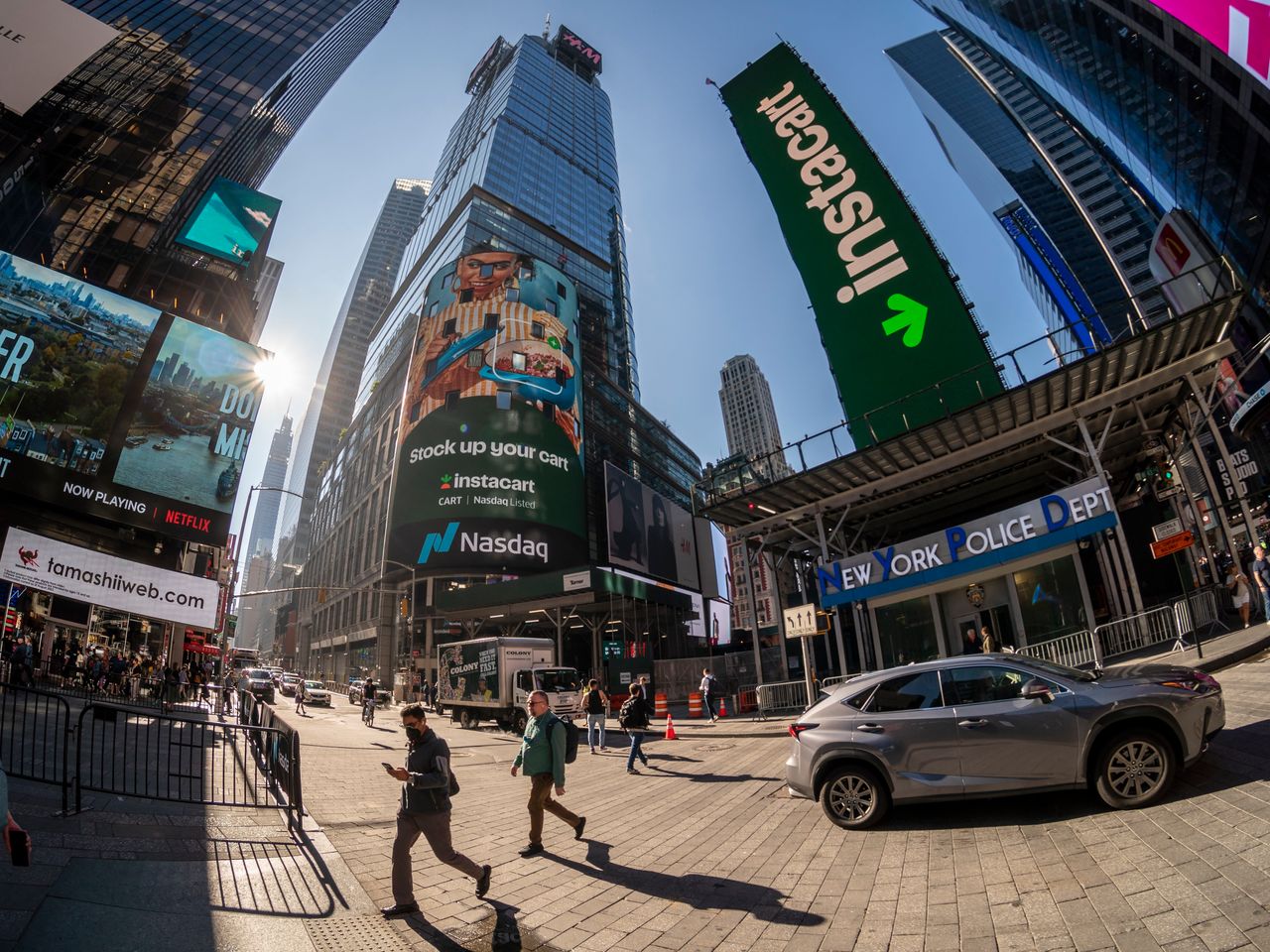
Instacart (CART.O), an American delivery company based in San Francisco that operates a grocery delivery and pick-up service in the United States and Canada, accessible via a website and mobile app on Tuesday announced that it anticipates its first-quarter gross transaction value (GTV) and core profit to surpass estimates, driven by an increase in grocery orders.
The company also revealed plans to streamline its operations by cutting 250 jobs, representing 7% of its workforce, to concentrate on “promising” initiatives.
Despite this positive outlook, shares of Instacart dipped approximately 5% after the bell, following the company’s fourth-quarter revenue figures falling below expectations due to a slowdown in the advertisement business.
As of June 30th, Instacart had 3,486 employees, according to regulatory filings.
CEO Fidji Simo addressed concerns about weakness among advertisers during a post-earnings call, stating that while there are some pockets of weakness, it is not widespread. However, ad and other revenues only increased by 7% in the fourth quarter, compared to a robust 19% growth in the previous quarter.
“Advertising business has slowed down,” remarked Arun Sundaram from CFRA Research, noting that this slowdown is a cause for concern given its historical status as a rapidly growing and high-margin business for Instacart.
Total revenue for the quarter rose by 6% to $803 million, slightly missing analysts’ expectations of $804.2 million. Transaction revenue growth also decelerated to 6%, as Instacart ramped up incentives and promotions to attract customers, especially during the holiday season, amid stiff competition from rivals like DoorDash (DASH.O), UberEats, Amazon.com. Spend less. Smile more. (AMZN.O), and Walmart (WMT.N).
Despite these challenges, total orders climbed by 5% to 70.1 million in the reported quarter, fueled by growth among newer customer segments.
Instacart forecasts its current-quarter GTV to range between $8 billion and $8.2 billion, surpassing analysts’ estimates of $7.92 billion. Additionally, it expects adjusted EBITDA to fall between $150 million and $160 million, compared to analysts’ estimates of $151.6 million, according to LSEG data.
Moreover, the company announced an additional $500 million share repurchase program and anticipates generating positive operating cash flow this year.