

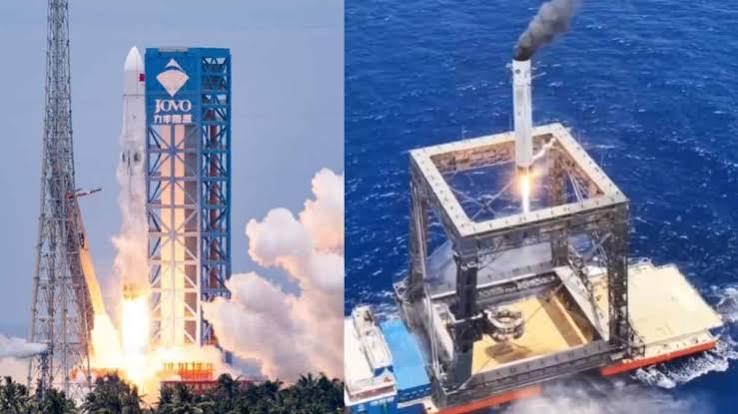
China’s state owned Aerospace Science and Technology Corporation has successfully launched a Long March orbital rocket and recovered its booster on a seagoing vessel, becoming the second country after the United States to achieve the feat. The milestone marks a significant step towards developing reusable rockets that could dramatically reduce the cost of future space missions.
Unlike SpaceX, which lands its Falcon 9 boosters on floating platforms, China’s recovery system uses a large net mounted on a recovery ship to capture the descending rocket. The company said it plans to reuse the recovered booster before the end of the year, bringing it closer to matching SpaceX’s reusable launch technology.
Space experts described the achievement as a major breakthrough that could strengthen China’s position in the global space industry. Victoria Samson of the Secure World Foundation said reusable rockets would significantly lower China’s launch costs and enhance its ability to offer affordable satellite launch services to partner countries, particularly across Africa, the Middle East and Southeast Asia.
The development is expected to intensify competition in the global space sector, especially in satellite communications where China’s ambitions increasingly rival those of SpaceX’s Starlink network. It also comes as several other companies, including Blue Origin, Rocket Lab and Stoke Space, continue efforts to develop next generation reusable rocket systems.