

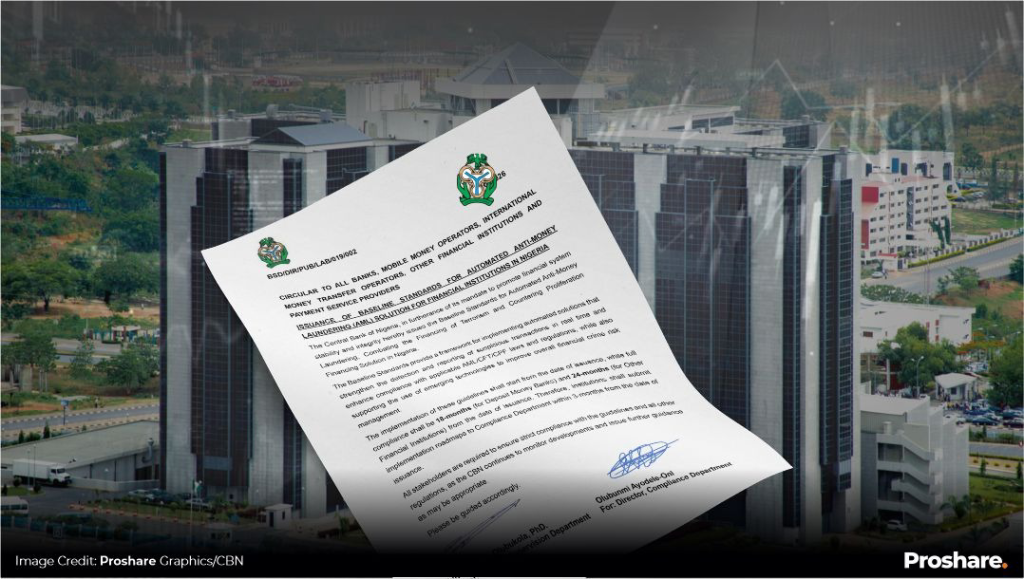
The Central Bank of Nigeria has formally introduced artificial intelligence into the country’s anti money laundering framework, directing banks, fintech companies and other financial institutions to adopt automated monitoring systems to detect financial crimes. The new guidelines mark the first time the regulator has explicitly incorporated artificial intelligence and machine learning into its compliance standards, signalling a major shift from largely manual oversight to technology driven financial surveillance.
Under the new rules, financial institutions are expected to deploy automated anti money laundering systems capable of identifying suspicious transactions, conducting risk based customer due diligence and reporting unusual financial activity to regulators. The regulator noted that the increasing digitisation of financial services, driven by mobile banking, fintech platforms and instant payment systems, has made traditional compliance tools inadequate for detecting complex financial crimes.
According to the central bank, the updated framework aligns with international standards promoted by the Financial Action Task Force and is intended to strengthen Nigeria’s capacity to detect money laundering, terrorism financing and proliferation related financial activities. Financial institutions are also required to report suspicious transactions to the Nigerian Financial Intelligence Unit while ensuring that their monitoring systems produce measurable compliance results rather than merely satisfying regulatory procedures.
The guidelines encourage the use of advanced technologies such as anomaly detection, behavioural pattern recognition and automated risk scoring to identify unusual financial activity. The regulator also recommended systems capable of detecting variations in names using intelligent matching techniques in order to improve screening for sanctioned individuals or politically exposed persons. However, the central bank warned that artificial intelligence systems must remain transparent and subject to strict governance, with institutions required to validate their machine learning models annually and ensure human oversight in decision making.
The directive forms part of a broader effort to strengthen fraud oversight in Nigeria’s financial sector amid rising digital transaction volumes and increasing fraud cases. Recent data from the Financial Institutions Training Centre showed that fraud losses in the banking sector rose sharply in early 2025. Under the new framework, deposit money banks have up to 18 months to fully comply with the standards, while other financial institutions are expected to implement the systems within 24 months, with the regulator warning that failure to meet the requirements could attract sanctions.