

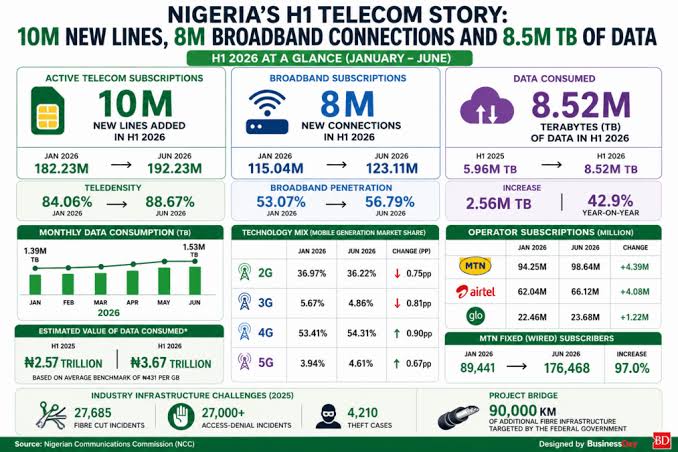
Nigeria’s telecommunications industry recorded significant expansion in the first half of 2026, adding about 10 million active subscriptions, more than eight million broadband connections and recording 8.52 million terabytes of internet data consumption. The latest figures from the Nigerian Communications Commission show that total telecom subscriptions increased from 182.23 million in January to 192.23 million in June, representing an increase of nearly 12 per cent compared with the 171.73 million recorded in June 2025.
The growth was also reflected in the country’s teledensity, which rose from 84.06 per cent to 88.67 per cent during the six month period. Broadband subscriptions increased from 115.04 million to 123.11 million, representing an additional 8.07 million connections, while broadband penetration rose from 53.07 per cent to 56.79 per cent. The development indicates growing reliance on high speed internet for online education, financial services, e commerce, remote work, entertainment and other digital activities.
Data consumption provided perhaps the clearest indication of Nigeria’s rapidly changing digital habits, rising from about 5.96 million terabytes in the first half of 2025 to 8.52 million terabytes during the corresponding period of 2026. This represents a 42.9 per cent increase within one year. Using an average benchmark of 431 naira per gigabyte, the volume of data consumed during the period was estimated at about 3.67 trillion naira in value, although the figure does not represent actual telecommunications industry revenue because data prices vary among operators and service plans.
The expansion, however, is placing greater pressure on Nigeria’s digital infrastructure. The NCC data showed that 4G accounted for 54.31 per cent of mobile network usage in June, while 5G increased from 3.94 per cent in January to 4.61 per cent. Industry stakeholders have consequently stressed the need for greater investment in fibre infrastructure, fixed broadband and other connectivity systems to meet rising demand. With homes increasingly serving as workplaces, classrooms and business centres, the challenge for the second half of 2026 will be to ensure that Nigeria’s telecommunications infrastructure expands quickly enough to support the country’s growing digital appetite.