

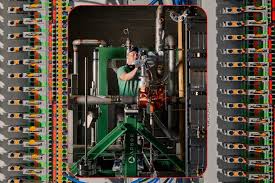
Arbor Energy, a U.S.-based energy startup, announced on Wednesday that it has sold up to 5 gigawatts of its next-generation modular turbines to GridMarket, a platform that arranges power infrastructure projects for data centers and industrial users. The order, which could translate to 200 units if fully delivered, marks one of the largest commitments for the company’s Halcyon turbine technology to date.
“Everyone wants more power. They wanted it yesterday,” said Brad Hartwig, co-founder and CEO of Arbor Energy, speaking to TechCrunch. “The time frames are compressing and the scale is getting larger.” Each Halcyon turbine, designed with rocket turbomachinery originally developed for spaceflight, will be 3D printed and capable of generating 25 megawatts. Although the financial details remain undisclosed, Hartwig indicated that the market has shown a willingness to pay upwards of $100 per megawatt-hour, with total transaction estimates reaching into the single-digit billions of dollars.
Arbor plans to connect its first turbine to the grid in 2028 and scale production through 2030, targeting an annual output exceeding 100 units. The long-term ambition is to supply enough capacity to generate 10 gigawatts of new power every year. Originally, the Halcyon turbines were designed to run exclusively on organic biomass — including crop waste and wood scraps — producing a carbon-negative energy output as CO2 emissions could be captured and sequestered underground.
In a recent design update, Arbor modified Halcyon to also accept natural gas, broadening its operational flexibility. While this allows turbines to run on a more widely available fuel source, it means that CO2 emissions are no longer fully negative. Hartwig emphasised that the company is working with low-leak natural gas suppliers and continues to prioritise carbon sequestration, projecting that Halcyon turbines could ultimately achieve less than 10 grams of CO2 per kilowatt-hour — a dramatic improvement compared with conventional natural gas plants, which emit roughly 400 grams per kilowatt-hour.
Despite this adjustment, Arbor has maintained its biomass-focused projects, though they remain smaller in scale compared to the GridMarket order. The startup’s rise coincides with a surge in demand from data centers, a sector that traditional turbine manufacturers have struggled to meet due to long, bottlenecked supply chains involving artisanal turbine blades and highly specialized labor. Hartwig highlighted that conventional suppliers would be unable to meet new demand quickly, with typical wait times extending to 2032.
Arbor’s approach leverages a combination of 3D-printed and machined components, which the company says allows it to reach the market faster. The startup’s strategy is to capture the urgent demand for power with scalable, modular turbines that are both high performance and adaptable to multiple fuel types.
“The market wants power in the next few years, and they want a lot of it,” Hartwig said, framing the company’s aggressive production timeline and technology adoption as critical advantages over legacy turbine manufacturers.
With the GridMarket deal, Arbor Energy positions itself at the forefront of a growing shift toward advanced, flexible energy solutions, combining rapid deployment, carbon-conscious technology, and scalability tailored to modern industrial and data-driven power needs.