

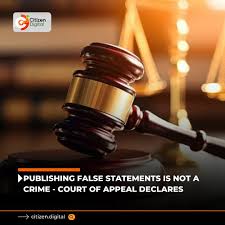
Kenya’s Court of Appeal has invalidated criminal penalties for publishing “false information” online, a landmark ruling that civil society groups say restores key protections for freedom of expression. Delivered in Nairobi on Friday, the decision struck down Sections 22 and 23 of the Computer Misuse and Cybercrimes Act 2018, citing their vagueness and conflict with constitutional guarantees for media freedom.
The case was brought by the Bloggers Association of Kenya (BAKE), Article 19 Eastern Africa, the Kenya Union of Journalists, and other civil society groups. Kennedy Kachwanya, chairperson of BAKE, described the ruling as “not just a win for content creators or journalists, but a win for every Kenyan who uses the internet to speak truth to power.”
A three-judge bench—Patrick Kiage, Aggrey Muchelule, and Weldon Korir—found the provisions on “false publications” and “false information” failed the constitutional test of clarity. The judges noted that the law could criminalise ordinary online speech, including satire, opinion, and journalistic errors, and could penalise individuals who unknowingly share inaccurate information.
The Court of Appeal’s decision marks a reversal of a High Court ruling in 2020, which had upheld most of the law. While the “false information” offences were struck down, the majority of the Computer Misuse and Cybercrimes Act remains intact, including powers for investigators to obtain warrants to search and seize digital data, issue production orders requiring service providers to release subscriber information, and conduct real-time data collection.
Offences targeting child sexual exploitation material and cybersquatting, which criminalises registering domain names in bad faith using another person’s trademark or identity, were also preserved.
Since the law’s enactment in 2018, bloggers, social media users, and journalists have faced investigations and arrests under the “false information” provisions, drawing repeated criticism from press freedom and digital rights groups. Activists argued that the law had become a tool for suppressing dissent online.
Mercy Mutemi, BAKE’s lawyer, said the ruling addressed the repeated misuse of “fake news” offences to target journalists, content creators, and the public. She stressed that while the decision was a major victory, concerns remain over sections of the law that enable surveillance and data collection.
The petitioners said they are reviewing the judgment and may pursue further legal action against provisions they argue continue to threaten privacy and civil liberties in Kenya’s digital space.
The ruling is being hailed by rights groups as a pivotal moment for online expression, signalling that Kenya’s courts are willing to scrutinise laws that risk curtailing freedom of speech under the guise of cybersecurity.
Digital experts and media advocates warn that while the “false information” offences are gone, continued vigilance is needed to ensure that Kenya’s cybercrime framework does not evolve into a tool for surveillance or censorship.