

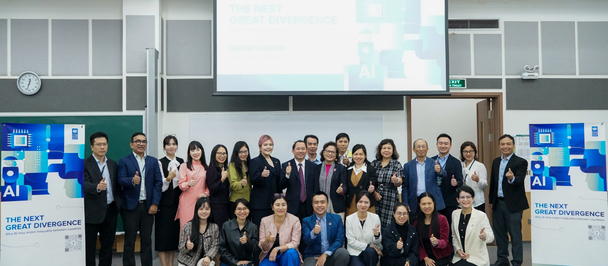
The Tuesday fresh warning from the United Nations Development Programme is forcing the world to confront an uncomfortable truth: artificial intelligence, despite its vast promise, could widen the gap between rich and poor nations in ways that undo decades of progress. In its new report, the UNDP cautions that the steady narrowing of global inequalities recorded over the last 50 years may be reversing, giving way to what it describes as a “great divergence” in economic opportunities, human capital and institutional strength.
The central message is straightforward but unsettling. Countries are not beginning the AI era from the same starting point. Nations with robust digital infrastructure, strong institutions and well-funded innovation ecosystems are positioned to take the lead. Meanwhile, those without these foundations risk falling behind as AI reshapes labour markets, industries and public administration.
Philip Schellekens, the UNDP’s chief economist for Asia-Pacific, highlight the scale of the challenge while speaking with journalists. He noted that the convergence that once lifted living standards, education and health outcomes in many developing countries is now at risk. The most troubling scenario, he explained, is one in which weaker economies see their development pillars eroded by a technological wave they lack the capacity to harness.
The report identifies three interconnected pressure points. The first is economic performance. AI has the potential to concentrate productivity gains and profits in a handful of advanced economies and dominant firms. The second is skills. Demand is rising for advanced digital and cognitive abilities, yet many nations lack the resources and systems to retrain their workforces at scale. The third is governance. Countries with fragile institutions may struggle to regulate, tax or guide AI in ways that protect the public or support inclusive development.
These concerns are not theoretical. The UNDP warns that unequal access to AI will be felt in real human terms—higher unemployment in vulnerable regions, slowing progress in health and education, and shrinking social mobility. For communities just beginning to benefit from globalization, the threat of slipping backward is immediate and deeply worrying.
Beyond economics, the report flags geopolitical and security implications. Schellekens and his colleagues argue that entrenched technological divides could fuel instability, increase irregular migration and complicate multilateral cooperation. A lopsided AI revolution would not stop at national borders; it would ripple across regions, shaping diplomacy, trade and security relations.
Importantly, the UNDP is not suggesting that AI is inherently harmful. It highlights the technology’s enormous potential to boost productivity, improve public services and unlock new sources of revenue. But it stresses that these benefits will not spread evenly unless deliberate policy choices guide them toward broader development outcomes.
To prevent a deepening divide, the report lays out a series of interventions. Key among them is heavy investment in digital infrastructure. Without reliable broadband, data systems and secure networks, poorer nations will struggle to participate meaningfully in the AI economy. Equally crucial is a renewed focus on education, especially lifelong learning and technical training to help workers transition into new roles created by AI.
The report also places strong emphasis on governance reforms. Countries will need capable institutions to regulate the technology, safeguard privacy, curb bias and ensure responsible use. For nations with limited capacity, international partnerships will be essential to build the regulatory and enforcement frameworks required for oversight.
Financing and technology transfer emerge as practical levers for reducing disparities. The UNDP calls on wealthy nations, global financial institutions and private investors to mobilize funds and expertise for developing economies. Concessional financing, targeted grants and collaborative public–private projects could help countries establish local AI ecosystems tailored to their needs.
The private sector is expected to play a strategic role. According to the report, technology companies and investors can support inclusion by sharing tools, nurturing local startups and designing products that function effectively in low-resource environments. But the UNDP is clear that voluntary efforts will not be enough; governments must set incentives that align private innovation with public interest.
Civil society and academia also feature in the recommended solutions. Local researchers can adapt global AI advances to national contexts, while community-based organizations can ensure that implementation reflects the needs of marginalized groups. Inclusive design, the report argues, is essential to avoid repeating old patterns of exclusion.
The UNDP acknowledges the complexity of the challenge. Even where AI increases productivity and state revenues, the gains may take years to translate into visible improvements in living standards. That lag makes early action critical. Without timely interventions, the gap between countries will widen, becoming more difficult to bridge.
In its closing message, the report blends pragmatism with moral clarity. The world must choose whether AI becomes a tool for shared prosperity or a force that entrenches new hierarchies of wealth and technological power. Its warning is a call to collective responsibility—a reminder that decisions made today will shape the next generation’s landscape of opportunity.
If left unaddressed, the emerging divergence would not only harm the world’s poorest countries, the UNDP argues; it would undermine global stability and shared prosperity. That is why the report frames its recommendations not as acts of charity, but as investments in global security and economic resilience. Helping nations adapt to AI, it insists, is ultimately a way of safeguarding the world’s future