

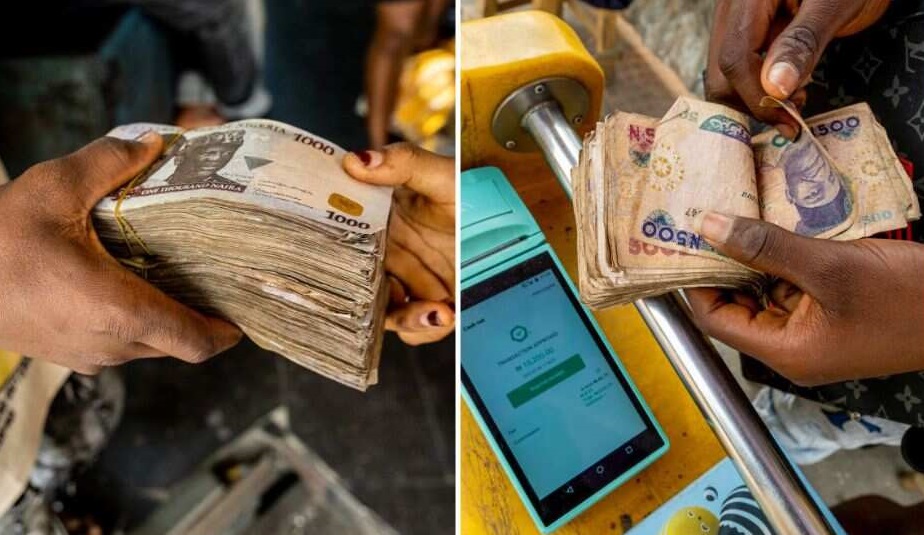
In response to the Central Bank of Nigeria’s (CBN) latest directive on cash withdrawal limits, Point of Sale (POS) agents are reportedly set to increase their fees to adapt to the new restrictions.
Point of Sale (POS) agents have become an essential part of Nigeria’s financial system, filling the gap left by traditional banking services, such as ATMs and over-the-counter transactions. Their importance grew as cash shortages made access to physical currency difficult, with many agents relying on informal sources like local businesses to maintain cash flow.
These operators, who can be found across all towns in Nigeria, especially at commercial nerve centers, charge between ₦30, ₦50 and ₦100 for every ₦1000 note provided. The payment can either be by ATM cards or bank transfers.
Meanwhile the country’s financial regulator, the Central Bank of Nigeria, CBN has imposed a daily cash disbursement cap of ₦1.2 million per POS agent and limited individual withdrawals to ₦100,000. These new limits pose challenges to POS operators, who play a key role in cash distribution, particularly after the 2023 cash scarcity caused by the currency redesign.
Interviews conducted by Remotework revealed that the restrictions threaten the viability of the POS business model, prompting agents to mull the adjustment of their service charges to offset what some like Yinka Abolade, a POS operator on the Adebayo axis of Ado Ekiti, a town in southwest Nigeria, described as a potential loss in revenue, to be transferred to the customer.
“We spend a lot of money to get the cash. Sometimes we have to queue at the bank ATMs multiple times a day to get the cash. And the limit per transaction is ₦10,000. Even our agents in the banks collect fees from us and have hinted the increase in charges”.
The CBN’s directive aims to regulate POS operations, reduce fraud, and encourage a shift towards a cashless economy. It also requires agents to register with the Corporate Affairs Commission (CAC) by September 2024 to ensure better oversight.
But many Nigerians lament the transfer of the extra costs to the customer like Sade Ogunsemoyin, a trader who depends on cash for daily market transactions.
“CBN should be blamed for non availability of Naira notes. You visit the ATM galleries but can’t get cash. Where do the POS operators get their cash? Is it not from the banks?”.
Some have queried the indifference to the POS operators by the CBN which is supposed to act as a regulator for the county’s financial system and the release of rules rather than complete and outright ban if the POS service sector and opting for monetary fines and other penalties.
 Philips Babatunde